Why Now Is a Great Time to Hunt for Tiny Homes in Florida
The tiny-home movement keeps gaining momentum across the United States, and Florida is no exception. As housing costs rise and more people look for affordable, flexible, and low-maintenance living options, interest in tiny homes (especially those that meet local building codes) is growing. On top of that, several Florida jurisdictions have begun adapting zoning and building-code rules to accommodate tiny homes, at least on a case-by-case basis, which means that for the right buyer with an eye for due diligence, now may be a sweet spot to take the leap.
Below I’ll walk you through the current tiny-home market and regulatory situation in Florida, and show how a home from MOMO Homes (by LuxMod Homes) can be a powerful, fast, and reliable way to realize that dream.
Tiny-Home Demand & Market Trends in Florida
Many Floridians are looking for housing solutions that are more affordable, more compact, and easier to maintain, especially as long-term rentals and traditional housing costs surge.
Tiny homes offer a way to downsize permanently, supplement an existing property (as an ADU or guest house), or for some, serve as a vacation or retirement retreat.
Interest in tiny-home communities, resale/rental tiny homes, and modular/panelized homes is growing which suggests an expanding market and gradually increasing acceptance.
However: supply is still limited, and many tiny homes remain on wheels or in RV/tiny-home parks rather than being fully permitted foundation-based dwellings. That makes a flexible but code-compliant option especially valuable for serious buyers.
Given these dynamics, buyers who come prepared — with zoning research, proper lot or land, and a realistic budget for utilities and permits can find tiny homes at a relative value compared with conventional housing, and get ahead of future demand growth.
Why Tiny Homes Are Rising in Popularity in Florida (Now More Than Ever)
Affordability gap & housing crisis
Florida is experiencing a serious shortage of affordable housing. The growth in population and in-migration has driven demand up, but supply (especially of entry-level homes and affordable rentals) hasn’t kept pace. (University of Florida News)
Many households in Florida are “cost burdened” paying a large share of their income toward housing. (Florida Realtors)
Traditional single-family homes (or even standard rentals) are increasingly out of reach. For example, median home prices across the state remain high, while median rent has also increased. (University of Florida News)
Changing household sizes & lifestyle preferences
Across the state, many households are smaller than in decades past (fewer people per household), meaning demand for large multi-bedroom homes has softened, while demand for more modest, efficient living spaces has grown. (Affordable Housing Conference 2026)
For singles, couples, retirees, or small families, tiny homes offer a lifestyle adjustment that meets current needs: less upkeep, less space wasted, lower utility bills, and easier maintenance. (Wolf Valley Buildings)
Sustainability, flexibility, and lower cost-of-living
Tiny homes consume fewer resources (energy, materials, water) which makes them attractive not only financially, but also to people interested in sustainability or lowering their ecological footprint. (Treasure Property Group)
Lower maintenance costs, smaller footprint, and the potential for simpler living draw people wanting to “downsize, declutter, and simplify life.” (Wolf Valley Buildings)
Market dynamics making tiny homes a sensible alternative
With standard single-family homes and apartments becoming expensive and competitive, tiny homes, especially panelized models, offer a faster-to-build alternative. This makes them attractive to first-time homebuyers, investors, retirees, and anyone seeking affordable homeownership or rental property. (R.E.I.G.N - Real Estate Investing)
For investors or property owners: tiny homes (or small-footprint homes) can help address the affordability gap in a high-demand rental environment, offering a niche for lower-cost, potentially high-ROI rentals. (Goshen Tiny Homes)
What Tiny Home Rentals (or Lot Rentals) Are Earning in Florida
Because “tiny home” in Florida can mean different things (tiny-home communities, tiny homes on wheels (THOWs), prefab tiny houses on private land/ADUs, etc.), the rental income or lot-rent numbers vary widely. Here are some real-world data points from recent sources:
Some tiny-house communities near Orlando for long-term rentals of tiny homes list monthly rents between $1,500 and $2,300 (including utilities, maintenance, furnishings) for fully furnished tiny homes. (tinytownorlando.com)
For lot-rent (land lease) — i.e. paying for the land but owning or bringing your own tiny home, some communities in Florida list rates between about $625 to $875 per month. (tinytownorlando.com)
More budget-oriented tiny-home parks / communities quote monthly lot rent (sometimes including utilities) from around $300 to $500 per month. (Little Houses for Sale)
For investors building or installing tiny homes on private land (or as ADUs), tiny homes’ lower build cost combined with rental demand can make them relatively high-ROI compared with traditional housing. (R.E.I.G.N - Real Estate Investing)
What this means in practical terms:
In many parts of Florida, a tiny home (or tiny-home community lease) can rent for similar or even slightly below conventional rental rate levels, but with much lower upfront cost and maintenance expenses. For owners/investors, that means lower capital requirement and potentially higher cash-on-cash return compared with traditional rentals.
Why MOMO by LuxMod Tiny Homes Are a Smart, Fast Route to Your Florida Tiny Home
If you are serious about building a tiny (or “small-home”) lifestyle especially one that meets code, lasts, and avoids the legal/permit risks of RV-style homes then a panelized/prefab home from MOMO deserves close consideration.
Here’s what sets MOMO by LuxMod tiny home apart for Florida buyers:
Panelized, foundation-compatible construction: MOMO homes are built with precision-engineered steel framing, roof, walls, and modern finishes AND they’re designed to meet local building codes (not treated as RVs). (Momo by LuxMod)
Fast build time: Because components are prefabricated off-site, once you have permits and lot prep done, assembly on-site is dramatically faster, weeks or a few months instead of a lengthy custom build. (Momo by LuxMod)
Durable & climate-ready: Their steel-framed, well-built homes are engineered to handle demanding weather, an important consideration in Florida (hurricanes, humidity, storms). (Momo by LuxMod)
Sustainability & efficiency: Many models include energy-efficient systems, and there are options for solar, efficient HVAC, etc. That fits well with Florida’s climate and with ongoing energy-cost concerns. (Momo by LuxMod)
Flexibility & customization: Whether you want a small ADU, a full tiny house, or a compact home MOMO offers a range of floor plans and finishes so you can tailor it to your needs without starting from scratch. (Momo by LuxMod)
In short: MOMO by LuxMod gives you the benefits of tiny-home living (compact, efficient, lower footprint) but with the robustness, legality, and design quality of a traditional home.
Unlocking Your Property's Potential: A Complete Guide to Additional Dwelling Units in Canada
Canada's housing market is experiencing unprecedented challenges. With affordability concerns reaching new heights and rental availability at historic lows, Canadian homeowners are discovering a powerful solution hiding in their own backyards: Additional Dwelling Units (ADUs).
Whether you call them ADUs, secondary suites, garden suites, or laneway houses, these self-contained residential units are transforming how Canadians approach homeownership, multigenerational living, and property investment. If you're a Canadian homeowner considering adding an ADU to your property, this comprehensive guide will walk you through everything you need to know.
What Exactly Are ADUs in Canada?
An Additional Dwelling Unit is a secondary, self-contained residential space located on the same property as your primary home. Unlike a simple basement renovation or room addition, ADUs are complete living spaces with their own kitchen, bathroom, sleeping area, and separate entrance.
In Canada, ADUs come in several forms:
Internal ADUs (Secondary Suites): Living spaces built within your existing home, such as basement apartments or converted attic spaces. These require minimal exterior changes and are often the most cost-effective option.
Attached ADUs: Units that share at least one wall with your main residence, like converted garages or side additions. These blend seamlessly with your existing structure while maintaining independence.
Detached ADUs (Garden Suites/Laneway Houses): Freestanding structures in your backyard that provide maximum privacy and separation from the main home.
The terminology varies across provinces. In Ontario, you'll often hear "Additional Dwelling Units," while British Columbia commonly uses "laneway houses" and "garden suites." Quebec refers to them as "accessory dwelling units," though regulations there remain more restrictive than in other provinces.
The Canadian ADU Market: Growing Fast
The ADU market in Canada is experiencing remarkable growth, driven by several converging factors. Provincial and municipal governments are actively updating regulations to make ADU construction easier and faster. Ontario's Bill 108 (More Homes, More Choice Act) has been particularly impactful, allowing properties to include up to three residential units where previously only one was permitted.
Cities like Toronto, Vancouver, Calgary, and Edmonton have streamlined their approval processes, recognizing ADUs as a crucial tool for addressing housing shortages without massive infrastructure investments. Even traditionally restrictive municipalities in Quebec are beginning to reconsider their stance as housing pressures mount.
This regulatory shift reflects a broader recognition: ADUs offer gentle density that increases housing supply while preserving neighborhood character. They utilize existing infrastructure like roads, sewers, and schools, making them a cost-effective solution for municipalities struggling to meet housing demand.
Financial Benefits: Income Potential and Property Value
The financial case for building an ADU in Canada is compelling, offering both immediate rental income and long-term property value appreciation.
Rental Income Opportunities
The rental income potential from a Canadian ADU varies significantly based on location, size, and amenities, but the returns can be substantial:
Long-term rentals provide stable, predictable income with less management intensity. A well-designed 600-800 square foot ADU in major Canadian cities can command monthly rents of $1,500 to $2,500 or more, depending on the market.
Short-term rentals (where permitted) through platforms like Airbnb can generate higher returns, particularly in tourist-friendly areas or near major attractions. However, many municipalities are implementing restrictions on short-term rentals to preserve long-term housing stock, so verify local regulations before planning for this income stream.
Multigenerational living might not provide direct rental income, but housing aging parents or adult children can offer significant financial benefits by reducing everyone's housing costs while keeping families close.
The rental income doesn't just pad your bank account—it can help qualify you for better financing options and offset your mortgage payments, property taxes, and maintenance costs. Many homeowners find that their ADU rental income covers 40-60% of their total property carrying costs.
Property Value Appreciation
Beyond rental income, ADUs typically increase property values by 20-30% according to real estate professionals. You're essentially creating two income-generating properties on one lot, which appeals to a much broader buyer pool when it's time to sell.
This value increase makes ADUs one of the few home improvements that can genuinely pay for themselves over time. While a kitchen renovation might recoup 60-70% of its cost at resale, a well-executed ADU often returns 100% or more of the initial investment through increased property value alone—before even considering years of rental income.
Tax Considerations
Canadian homeowners should note that rental income from ADUs must be reported to the Canada Revenue Agency. However, you can deduct numerous expenses including:
Mortgage interest (proportional to the ADU's share of the property)
Property taxes (proportional share)
Utilities
Maintenance and repairs
Insurance premiums
Property management fees
Additionally, you may be able to claim Capital Cost Allowance (depreciation) on the ADU structure itself, though this can have implications for your principal residence exemption when selling. Consult with a Canadian tax professional to optimize your tax strategy.
What Does It Cost to Build an ADU in Canada?
Understanding construction costs is essential for planning your ADU project. In Canada, total ADU construction costs typically range from $130,000 to $350,000 or more, depending on numerous factors.
Cost Breakdown by Type
Internal/Basement ADUs: $40,000 - $120,000
Converting existing space is generally the most affordable option since you're working with an existing foundation and structure. Costs focus on finishing work, separate entrance creation, and code compliance.
Attached ADUs: $80,000 - $200,000
These share utilities and structural elements with your main home, reducing some costs while still providing substantial independence.
Detached ADUs: $150,000 - $300,000+
As standalone structures requiring their own foundation, complete utility connections, and all-new construction, detached ADUs represent the highest investment but offer maximum flexibility and privacy.
Where Your Money Goes
Understanding how your ADU budget breaks down helps you make informed decisions:
Design and Planning (8-15%): Architectural drawings, engineering, permits, and structural design
Foundation and Site Work (10-15%): Excavation, concrete, site preparation
Structure and Framing (20-30%): The building envelope, walls, roof
Systems and Utilities (15-20%): Plumbing, electrical, HVAC, utility connections
Finishes (25-35%): Flooring, fixtures, appliances, paint, trim
Permits and Fees (5-10%): Building permits, development charges, inspections
Hidden Costs to Consider
Many first-time ADU builders underestimate these additional expenses:
Utility connection fees can range from $5,000 to $15,000 depending on your property's existing infrastructure
Soil testing and remediation if ground conditions are challenging
Tree removal or protection (some municipalities have strict tree preservation bylaws)
Temporary housing during construction if you're converting a space you currently use
Post-construction landscaping and pathway restoration
Canadian Financing Options
Several financing programs can help make your ADU project more affordable:
The federal Canada Secondary Suite Loan Program offers up to $80,000 in low-interest loans (2% interest rate over 15 years) specifically for creating secondary suites. This program launched in early 2025 and aims to increase rental housing availability.
Many municipalities offer additional incentives. For example, Lambton County in Ontario provides loans up to $25,000 or 75% of total project costs (whichever is less) to eligible homeowners building ADUs.
Traditional financing options include home equity lines of credit (HELOCs), cash-out refinancing, or construction loans. The advantage of a HELOC is flexibility—you only pay interest on what you borrow, and you can draw funds as needed throughout construction.
Why Panelized Construction Is the Smart Choice
When it comes to actually building your ADU, the construction method you choose can significantly impact your timeline, budget, and final result. While traditional stick-built construction remains common, panelized construction offers compelling advantages that make it increasingly popular for Canadian ADU projects.
Understanding Panelized Construction
Panelized construction involves fabricating major building components, walls, floors, and sometimes roof sections, in a climate-controlled factory setting. These precision-engineered panels are then transported to your property and assembled on-site, typically in a matter of days rather than weeks or months.
Think of it as the difference between building with LEGO blocks versus assembling individual bricks. The components are designed specifically for your project, manufactured to exacting standards, then quickly assembled on your property.
Speed and Weather Independence
Perhaps the most significant advantage of panelized construction for Canadian homeowners is speed. A panelized ADU can reach weather-tight status in just days, with complete construction often finished in 10-12 weeks compared to 4-7 months for traditional stick-built construction.
This matters tremendously in Canada's climate. Stick-built projects are vulnerable to weather delays—rain, snow, extreme cold, and wind can halt construction for days or weeks, stretching timelines and increasing costs. Each delay means paying your construction crew to essentially wait around, watching your budget evaporate.
Panelized construction flips this equation. The bulk of construction happens in a factory where weather is irrelevant. When panels arrive at your site, assembly happens quickly regardless of season. Your construction window shrinks from months to weeks, dramatically reducing the risk of weather-related delays and cost overruns.
For Canadian homeowners planning fall or winter projects, this advantage cannot be overstated. You're not gambling on having good weather for months on end—you need just a few days of decent conditions for the main assembly.
Superior Quality and Consistency
Factory construction environments provide quality control advantages that are impossible to replicate on a job site. Panelized components are built on level surfaces, using precision equipment, with consistent supervision and quality checks at every stage.
This controlled environment means:
More accurate cuts and measurements
Better material storage (no warped lumber from sitting in rain or snow)
Consistent workmanship from specialized factory teams
Reduced human error from weather fatigue or rushed timeline
Built-in quality checkpoints before components leave the factory
The result is a structurally superior building with fewer callbacks, corrections, and warranty issues. Panels fit together precisely, creating better seals, fewer drafts, and improved energy efficiency compared to field-assembled construction where conditions and rushing can compromise quality.
Significant Cost Advantages
While panelized components might initially appear to cost 10% more than purchasing raw materials for stick building, this narrow comparison misses the complete picture. When you account for all project costs, panelized construction typically comes out ahead:
Reduced Labor Costs: Panelized systems require smaller crews with less specialized framing skills. A lead person with general laborers can install panels, whereas stick-building requires experienced framers. This labor efficiency translates to 30-40% lower on-site labor costs.
Minimal Material Waste: Factory construction produces approximately 25% less waste compared to stick-built methods. Every panel is precision-cut for your specific project—no excess materials, no off-cuts filling dumpsters. This means lower material costs, fewer dumpster fees, and reduced environmental impact.
Eliminated Theft and Damage: Building materials sitting on job sites for weeks or months are vulnerable to theft, vandalism, and weather damage. Panels arrive and are installed immediately, virtually eliminating these losses.
Faster Project Completion: Time is money in construction. Shorter construction timelines mean fewer interest payments on construction loans, reduced carrying costs, and faster time to rental income. If you're financing your ADU, shaving 2-3 months off your timeline can save thousands in interest alone.
Predictable Pricing: Because panelized manufacturers quote complete packages based on your plans, you're protected from the price fluctuations and "surprise" overages common with stick-built projects. Your quote is your price—no inflation adjustments for materials purchased months into construction.
Energy Efficiency and Sustainability
Panelized construction, particularly with Structural Insulated Panels (SIPs), delivers exceptional energy performance. These systems provide continuous insulation without the thermal bridging common in stick-built walls, where wooden studs create pathways for heat loss.
The airtight construction of panelized buildings reduces drafts, lowers heating and cooling costs, and improves indoor air quality. For Canadian climates with temperature extremes, this efficiency translates to hundreds of dollars in annual energy savings.
From a sustainability perspective, panelized construction's reduced waste, efficient material usage (80% less lumber than comparable stick-built structures), and superior energy performance make it the environmentally conscious choice. Many Canadian municipalities now offer green building incentives that can offset construction costs for energy-efficient projects.
Addressing Panelized Misconceptions
Some homeowners worry that panelized construction limits design flexibility. This is a misconception rooted in confusion between panelized and modular construction. Modular homes are fully completed boxes with limited customization. Panelized systems, by contrast, are simply a construction method—the panels can be manufactured to virtually any design specification.
Your ADU can have custom windows, unique rooflines, specific architectural details, and personalized layouts. The design is yours; the panels are simply a smarter way to build it.
Another concern is transportation costs for large panels. While this is a valid consideration, most panelized manufacturers have optimized panel sizes for standard truck transport, and the transportation cost is typically more than offset by the labor, waste, and timeline savings.
Navigating Canadian ADU Regulations
Every municipality in Canada has specific regulations governing ADU development. While we can't cover every jurisdiction, here are the key regulatory considerations:
Size Restrictions
Most Ontario municipalities require that ADUs remain smaller than the primary dwelling, with typical maximum sizes around 800-860 square feet. Some cities allow larger units on bigger lots or when specific criteria are met.
British Columbia municipalities have varying size limits, often calculated as a percentage of the main dwelling or lot coverage. Vancouver, for example, allows laneway houses up to 60% of the principal dwelling's floor area.
Parking Requirements
Unless municipal bylaws specify otherwise, many jurisdictions require one parking space per ADU. However, this requirement is increasingly being waived or reduced in urban areas near transit, recognizing that additional parking requirements can make ADU projects financially unviable.
Owner Occupancy
Some municipalities require that either the primary residence or the ADU be owner-occupied, preventing pure investment properties. However, Ontario's provincial regulations prohibit municipalities from imposing owner-occupancy requirements on new ADUs, though some older bylaws may still be in effect pending updates.
Zoning and Eligible Properties
ADU development is generally permitted on properties zoned for single-detached homes, semi-detached houses, and street-facing townhouses across Ontario. British Columbia has similar broad eligibility, though specific lots may have additional restrictions based on heritage designation, size, or environmental factors.
The Approval Process
While processes vary by municipality, most follow a similar pattern:
Pre-Application Consultation: Meet with your municipal planning department to understand specific requirements for your property
Design and Planning: Work with designers/architects to create plans that meet all codes and bylaws
Permit Submission: Submit building permit application with complete plans, engineering reports, and required fees
Review Period: Municipality reviews your application (4-10 weeks typically)
Permit Issuance: Once approved, receive your building permit
Construction: Build according to approved plans with required inspections
Final Inspection and Occupancy: Receive occupancy permit once all inspections pass
Many municipalities have established streamlined "as-of-right" processes for standard ADUs that meet specific criteria, significantly reducing approval times and complexity.
Is an ADU Right for You?
Building an ADU is a significant investment and undertaking. Here are questions to help determine if it's the right choice:
Financial Readiness: Can you finance the construction? Do you have sufficient equity in your property for a HELOC or refinancing? Have you explored available grants and incentive programs?
Long-Term Plans: Do you plan to stay in your home long enough to recoup the investment? Are you prepared to be a landlord if pursuing rental income?
Property Suitability: Is your lot large enough? Does it have adequate access for construction? Are there site challenges like steep slopes or poor drainage?
Time and Energy: Are you prepared to navigate the permitting process and manage construction? Do you have time to oversee the project or funds to hire a project manager?
Market Demand: Is there rental demand in your area? What are comparable units renting for? Will the numbers work?
Getting Started with Your ADU Project
If you're ready to explore adding an ADU to your property, here's how to begin:
Research Local Regulations: Contact your municipal planning department to understand what's permitted on your specific property. Many municipalities now have ADU-specific resources and guides available online.
Assess Your Property: Evaluate your lot's physical characteristics, existing utilities, access, and potential building locations.
Define Your Goals: Be clear about why you're building. Rental income? Family housing? Home office? Your goals will guide design decisions.
Explore Financing: Connect with lenders about your options. Factor in available government programs and incentives.
Connect with Panelized Builders: Contact companies specializing in panelized ADU construction like MOMO by LuxMod. Request quotes and timelines. Compare their offerings with traditional builders to see the difference in approach, cost, and timeline.
Develop Your Design: Work with your chosen builder to create a design that meets your needs, fits your lot, and complies with all regulations.
Secure Permits: Submit your application and work through any requested modifications.
Build: Let the construction process begin, with regular inspections and oversight.
Prepare for Occupancy: Once construction completes, obtain your occupancy permit and either move in your tenant/family member or list the space for rent.
The Bottom Line
Additional Dwelling Units represent one of the most significant opportunities available to Canadian homeowners today. They address critical housing supply issues while creating financial benefits for property owners. With streamlined regulations, supportive financing programs, and advanced construction methods like panelized building, there's never been a better time to explore adding an ADU to your property.
Whether you're looking to generate rental income, accommodate family members, or simply increase your property's value and utility, an ADU can help you achieve those goals. By choosing panelized construction, you'll benefit from faster timelines, superior quality, better energy efficiency, and more predictable costs—advantages that make your ADU project more likely to succeed and more profitable over the long term.
The Canadian housing market needs more supply, more flexibility, and more creative solutions. Your backyard might just hold the answer.
Ready to explore adding an ADU to your property? Start by contacting your local planning department to understand what's possible on your lot, then reach out to panelized construction specialists like MOMO by LuxMod to discuss how modern building methods can bring your vision to life faster and more efficiently than traditional construction.
ADU Revolution: Lot by Lot
You feel it, don’t you?
The pressure. The squeeze.
Like invisible hands tightening around the throat of every homeowner, every renter, every family just trying to exist.

For years, the hedge funds, the corporate landlords, the foreign capital pipelines — they’ve been playing Monopoly with our neighborhoods.
Buying whole streets.
Outbidding entire communities.
Inflating prices, draining equity, and turning the American dream into a subscription service.
And they think we didn’t notice.
They think we’re too distracted… too divided… too defeated.
But we see you.
We’ve always seen you.
You’ve treated real estate like a casino.
You’ve treated people like chips.
You’ve treated homes — homes — like they’re just another asset to squeeze until they bleed.
But here’s the part of the story you didn’t calculate for:
We’re done playing your game.
No more waiting.
No more begging for affordability.
No more praying that the market magically “fixes itself.”
We are fighting back — one lot at a time.
Because the ground beneath our feet?
You forgot who actually owns it.
ADU by ADU… parcel by parcel… we’re breaking your grip.
Not with riots. Not with chaos.
But with strategy.
With intelligence.
With the one thing you fear most: people realizing their power.
MOMO Homes ADUs by LuxMod is our crowbar.
Fast builds. Stronger materials. High-efficiency systems.
A way for ordinary people to multiply doors, multiply equity, multiply value — without ever asking your permission.
You buy neighborhoods?
Fine.
We’ll build inside the ones you can’t touch.
You inflate prices?
Fine.
We’ll create value out of thin air — with faster installs in weeks, not months.
Every ADU placed is a middle finger to the machine.
Every family that gains cash flow is a breach in your firewall.
Every homeowner who grows equity is another fracture in your financial empire.
This isn’t vandalism.
This is revenge.
This is reclamation.
You took homes.
We’ll build them back.
You took value.
We’ll generate more.
You took power.
We’re taking it back.
And listen closely — because this part matters:
We’re not stopping.
Not tomorrow.
Not next year.
Not when the market shifts.
Not when you finally realize you can’t buy your way out of this one.
We will keep building.
Keep teaching.
Keep spreading.
Keep empowering.
Until the system bends.
Until communities rise.
Until equity returns to the people who earned it — not the ones who exploited it.
This is the quiet revolution they never saw coming.
A homeowner uprising written in permits and ADUs.
One lot at a time.
One build at a time.
One victory at a time.
We are the people.
We are awake.
And we will not stop
— ever —
until we are victorious.
The Clock is Ticking: Your Last Chance to Lock in 2025 Pricing on ADU Home Kits
The holiday season brings more than just twinkling lights and warm gatherings—it brings an unprecedented opportunity to invest in your future home or ADU at prices that won't last. But here's the catch: time is running out faster than you might think.
Your Year-End Savings Window
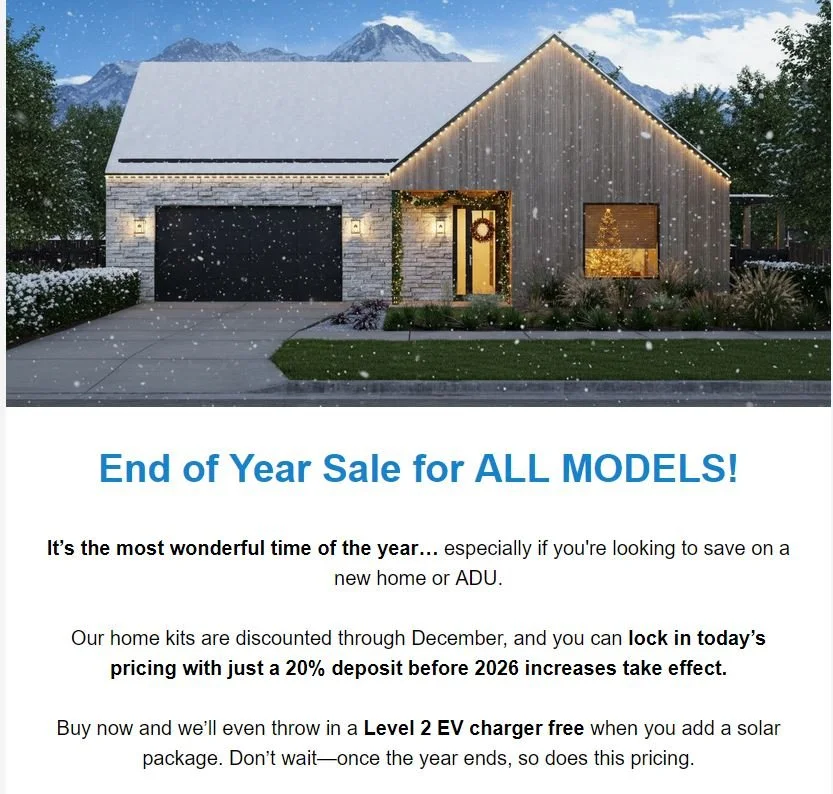
At The ADU Wizard, we're offering something we don't shout about every day: a genuine, no-strings-attached discount on ALL MODELS through December. But this isn't just any sale. This is your chance to lock in today's pricing by putting down just a 20% deposit before 2026 price increases take effect.
Think about it. The housing market waits for no one, and neither do material costs. Every year brings new pressures on the industry. By acting now, you're not just getting a discount—you're protecting yourself from the inevitable increases coming in the new year.
The Bonus That Makes It Even Better
Here's where this gets really interesting. Add a solar package to your order, and we'll throw in a Level 2 EV charger absolutely free. That's not a limited promotion or fine-print offer. That's us saying thank you for choosing to build your ADU with us during this special window.
A Level 2 EV charger typically costs thousands. If you've been thinking about going solar anyway, this addition turns an already smart investment into an exceptional one. You're looking at a home kit that's future-proof, energy-independent, and ready for electric vehicles—the direction the world is moving.
But There's Something Critical You Need to Know
Now, we need to be completely transparent about something that affects orders placed starting December 1st: Chinese New Year production slowdowns.
Our factory partners around the world honor this significant holiday. It's not just a day off—it's an extended break that runs through February 1st. What does this mean for you?
An order placed on December 1st is effectively the same as placing your order on February 1st.
Let that sink in. You could be waiting 8+ weeks longer than necessary simply because of timing.
The Real Deadline
While the sale runs through December, the actual critical date is November 30th.
Any order confirmed by the end of November will be processed and move through production before the holiday break. Any order placed after that date enters a queue that won't budge until early February.
If you're already behind on a timeline, this delay could push your project further into spring—a time when weather and construction schedules become less favorable in many regions. For some, it means missing an entire building season.
Here's What We Recommend
If you've been considering an ADU—whether it's for a guest house, rental income, aging parents, or your own downsized living situation—now is the moment to act. Not because of artificial urgency, but because the stars genuinely align right now:
Lock in today's pricing with a manageable 20% deposit
Get that free Level 2 EV charger if you add solar
Avoid the 8+ week holiday production delay by ordering before December 1st
Stay on schedule for your spring or summer build
The Bottom Line
This is the most wonderful time of the year for a reason. It's when we give thanks, plan for the future, and make decisions that matter. If you've been dreaming about adding an ADU to your property or building your own home, you now have the pricing incentive, the free upgrade opportunity, and the production window all aligned in your favor.
But that alignment doesn't last forever. In just weeks, the year will turn. Prices will rise. Production delays will begin. The opportunity will have passed.
The question isn't whether you should act. It's whether you'll act in time.
Ready to get started? Visit The ADU Wizard today and secure your order before the year ends. Your future home (and your future self) will thank you.
Have questions about our home kits, solar packages, or the production timeline? Our team is ready to help you make the right decision for your unique situation. Don't let this opportunity pass you by.
How much value will an ADU add to my property, and is it a good investment in San Diego’s market?
How Much Value Does an ADU Add in San Diego?
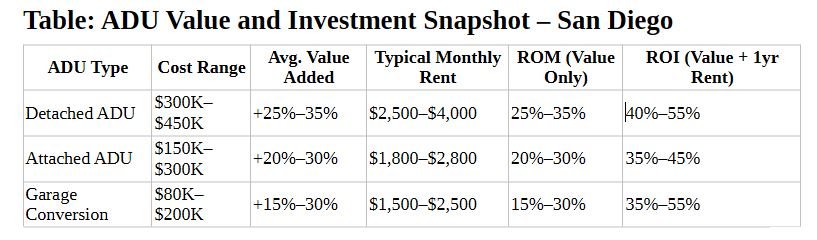
Properties with legal, permitted ADUs in San Diego sell for 25–35% more on average than comparable homes without ADUs.
In dollar terms, many San Diego homeowners see $200,000 or more in added value after completing an ADU, with some reports of smaller units costing about $200,000 and yielding $300,000 in increased equity.
National data backs this up: California homes with ADUs often sell for up to 35% above similar homes without, according to the National Association of Realtors.
Is an ADU a Good Investment?
Rental Income Potential: ADUs typically rent for $1,900–$3,700 per month, depending on size and location (studios to 2-bed units).
ROI and Payback: Typical ROI (return on investment) for detached ADUs in San Diego is estimated at 25%–35% just from value added, and 40%–55% when first-year rental income is included.
Strong Demand: Homes with ADUs often sell faster, up to a month sooner, due to higher buyer interest from both investors and multi-generational families.
Long-term Appreciation: Properties with ADUs appreciate at about 9.3% annually, outpacing homes without ADUs which average 7.7%.
Versatility: An ADU can be used for rental, home office, guest housing, or family, adding flexibility and market appeal.
Rental Income Example: A well-located 2-bedroom ADU renting for $3,000/month can gross $36,000/year, easily offsetting financing payments and generating positive cash flow.
Factors That Influence Value Added
Size, Design, and Quality: Larger, well-finished units tend to add more value. (MOMO Homes by LuxMod is a strong contender as the come complete with high end finishes and include all appliances!)
Neighborhood and Demand: ADUs built in high-demand areas or near transit and jobs generally see the strongest returns.
Permitting: Only properly permitted ADUs unlock full market value; unpermitted units may not be counted by appraisers or buyers and can cause headaches!
Rental Strategy: Long-term rentals deliver steady income, while short-term rentals (where allowed) can further boost ROI.
Table: ADU Value and Investment Snapshot – San Diego
Conclusion:
Building an ADU in San Diego can boost your property’s value by up to 35%, or more, provide strong ROI and deliver reliable rental income. For many local homeowners, an ADU is a smart investment with lasting benefits for equity, flexibility, and resale potential, especially in one of California’s most competitive housing markets.
Sources:
https://www.blockrenovation.com/guides/how-much-value-does-an-adu-add-in-california-markets
https://waymakerca.com/blog/how-adus-impact-san-diego-home-value-and-resale
https://www.kbbeyond.com/post/how-profitable-are-adus-profit-potential-from-an-adu-in-san-diego
https://www.housetohome.com/what-value-does-an-adu-add-for-your-home-in-san-diego/
https://snapadu.com/blog/roi-adu-good-investment-valuation-appraisals/
https://streamlinedesigngroup.com/blog/garage-adu-conversion-cost