The Expert Guide to Minnesota Tiny Homes and ADUs
Are you a Minnesota homeowner looking to add rental income, a family member, or a dedicated home office? Perhaps you're a downsizer dreaming of a minimalist life on the North Shore or in a cozy Twin Cities backyard. Minnesota tiny homes and ADUs (Accessory Dwelling Units) are one of the state's fastest-growing housing solutions.
This comprehensive guide offers practical, localized advice for navigating the unique climate, complex zoning, and exciting opportunities in the North Star State. It will provide the MN-specific context you need—from frost depth requirements to Twin Cities regulations—to make your tiny home or ADU dream a reality.

What Counts as a Tiny Home or ADU in Minnesota (MN-Specific Definitions/Terms)
While often used interchangeably, "Tiny Homes" and "ADUs" have distinct legal definitions in Minnesota, primarily driven by size and foundation. Understanding these differences is crucial for permitting and zoning.
Accessory Dwelling Unit (ADU): An ADU is a secondary, self-contained dwelling unit on a single-family lot. It must include a kitchen, bathroom, and sleeping area. ADUs can be attached (like a basement or above-garage apartment) or detached (a backyard cottage). Most local ordinances limit their size, typically to a maximum of 700 to 1,000 square feet, and often require the property owner to occupy either the main house or the ADU.
Tiny Home (Permanent Dwelling): In Minnesota, a tiny home built on a permanent foundation is typically defined as a residential dwelling unit of 400 square feet or less that follows the Minnesota Residential Code, which incorporates Appendix Q of the International Residential Code (IRC). This classification means it's treated like a small house, requiring standard building permits and compliance with local setbacks.
Tiny Home on Wheels (THOW): THOWs are generally built to RV standards (NFPA 1192 or ANSI A119.5). These units are not typically permitted for full-time residence on private land in most Minnesota municipalities due to zoning and utility hookup regulations. They are usually restricted to licensed RV parks, seasonal resorts, or as temporary housing (with permits) in many areas.
Quick Take: If you are planning a permanent dwelling on a foundation, you will be following the Minnesota Residential Code. If it’s a secondary unit on your property, you're building an ADU, and local zoning will dictate the specific size and placement rules. Always check with your city's planning department.
Top Providers, Builders, and Venues (MN + Upper Midwest)
The Minnesota market is served by a blend of local, hyper-specialized builders and larger, regional modular and prefab companies. When selecting a partner, prioritize one with documented experience meeting the stringent MN building code, especially concerning insulation and climate.
Local MN Tiny/ADU Specialists: Look for boutique design/build firms, particularly in the Twin Cities area, that specialize exclusively in ADUs. These local experts have a deep understanding of municipal zoning variations and local permitting offices.
Modular/Prefab/Panelized Builders (Upper Midwest): Many excellent modular home providers in the Upper Midwest (Wisconsin, Iowa, Minnesota) offer models that fit the ADU size constraints and are built in a controlled environment to a high standard, which can simplify construction time.
Custom Home Builders: For high-end or highly specific site challenges, many general contractors with a residential portfolio can take on an ADU project, though you will need a clear design to start.
Venues & Communities: While dedicated tiny home villages are still rare, many RV parks and seasonal resorts along the North Shore or in the Brainerd Lakes area allow "Park Model RVs" (often larger than a THOW but smaller than a traditional cabin). Be sure to check their seasonal restrictions.
Pricing and Total Cost Breakdown
The cost of a tiny home or ADU in Minnesota is not just the sticker price of the unit; site work and code compliance are major financial factors in a cold climate.
Disclaimer:These are 2023–2025 market estimates for the Minnesota region. Actual costs vary widely based on size, finish level, location (site work in Duluth's hills is different from flat Woodbury), and contractor selection.
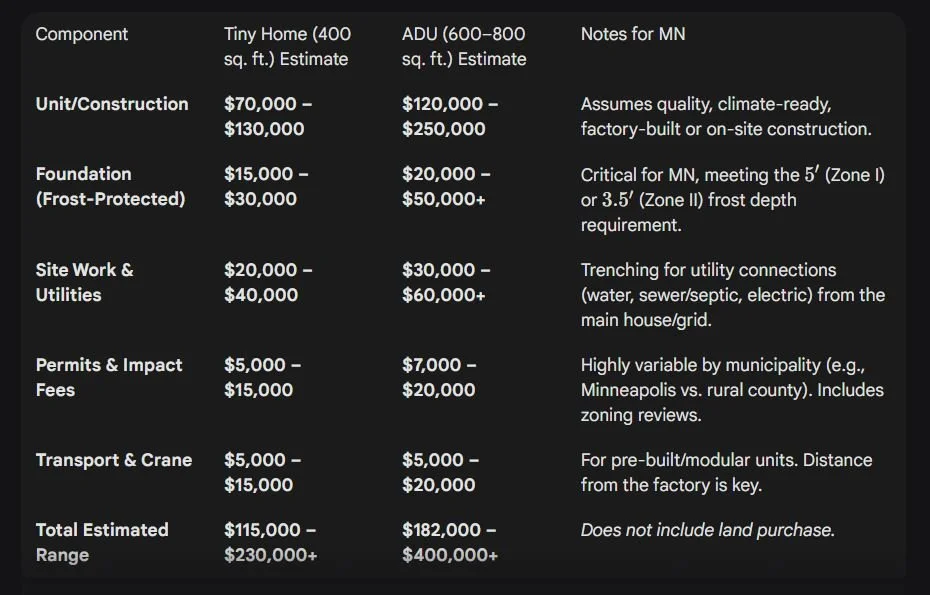
The Winterization Premium: The cost difference per square foot for materials like higher R-value insulation (see below), specialized vapor barriers, and robust heating systems means MN construction is inherently more expensive than in warmer climates.
Permits, Zoning, and Local Regulations
Navigating the local bureaucracy is often the most time-consuming part of an ADU or permanent tiny home project in Minnesota. State code provides the baseline (like the 400 sq. ft. max for a tiny home classification), but *local zoning* dictates what is allowed on your specific property.
Statewide Context: All permanent dwellings must comply with the Minnesota State Residential Code (based on the IRC). This covers structural integrity, plumbing, and energy efficiency.
City/County Examples (Detached ADUs):
Minneapolis & St. Paul: Both cities generally permit ADUs (backyard cottages). Minneapolis has historically been more proactive, often allowing ADUs by right in single-family zones, while St. Paul has similar, recently updated ordinances.
St. Louis Park & Edina: These affluent suburbs are becoming increasingly ADU-friendly, often setting maximum sizes (e.g., Edina up to 1,000 sq. ft. or the size of the main unit, and requiring owner-occupancy).
Rochester: Home to the Mayo Clinic, Rochester is actively encouraging ADUs to alleviate housing shortages, often with clear, dedicated application processes.
Duluth & North Shore: Regulations can be stricter or vary greatly by township. Lake Superior shoreline setbacks and terrain challenges must be considered alongside typical city zoning.
Must Verify: You must verify your property's specific zoning, setback requirements (distance from lot lines), height restrictions, and whether a conditional use permit (CUP) or rental license is required with your city or county's Planning/Community Development Department.
Seasonal and Climate Considerations
The Minnesota climate demands a non-negotiable focus on robust design and superior materials to ensure comfort and longevity.
Frost Depth Protection: To prevent movement and structural damage from our deep frost, foundations must be placed below the minimum frost depth, which ranges from 5’ (60 inches) in Zone II to 6.5’ (78 inches) or more in Zone I (Northern MN, depending on county engineer determination). This is why a simple slab won't suffice.
Insulation and R-Values: The Minnesota Energy Code mandates high R-values (a measure of thermal resistance) to combat extreme cold. Expect requirements such as R-49 in the ceiling/attic, and R-21 for wood frame walls in most of Climate Zone 7. Prioritize continuous insulation to minimize thermal bridging.
Snow Load: Roofs must be engineered to withstand significant snow accumulation, especially on the North Shore or in northern counties. Your builder must calculate the appropriate live load for the location.
Energy Efficiency: A well-insulated tiny home or ADU is ideal for MN. Consider high-efficiency mini-split heat pumps for both heating and cooling, which are well-suited for smaller spaces and provide excellent energy savings.
Insider Tips and Buying Checklist
Use this checklist before you commit to a design or builder to ensure you've covered the MN essentials.
Zoning Pre-Check: Contact your city or county before hiring a designer. Get a clear understanding of maximum height, size (sq. ft.), setbacks, and owner-occupancy rules.
Utility Path: Locate your existing main sewer/septic line and water line. The cost of running utilities to a detached unit is often the biggest unexpected expense.
Foundation Type: Confirm your builder is planning a permanent, frost-protected foundation (such as a full basement, crawlspace, or frost-protected shallow foundation) that meets local frost depth requirements.
HVAC for Cold: Ensure your heating system is rated for extreme cold (Zero F or below). Look for Hyper-Heat or cold-climate rated mini-splits.
Water Management: Verify the design includes a proper vapor barrier and air sealing to prevent condensation and moisture damage, which is a common issue in tightly sealed, cold-climate homes.
Neighborhood and City-by-City Guidance
While the Twin Cities lead in ADU adoption, opportunities exist throughout the state. Remember: rules change, so always check the current code!
Twin Cities Metro Area (MSP)
Minneapolis/St. Paul (The Core): Often the most progressive, allowing ADUs in almost all residential zones. Rules are clearly documented and streamlined for attached and detached units.
St. Louis Park, Edina, Bloomington: These first-ring suburbs have adopted robust ADU ordinances. Owner-occupancy is a common requirement to prevent over-rental of neighborhoods.
Maple Grove, Woodbury, Stillwater: Policies vary, with some communities having stricter or more recent ordinances regarding lot coverage, size limits, and architectural compatibility with the main home.
Greater Minnesota & Regional Hubs
Duluth & North Shore: Expect stringent codes due to the challenging terrain (hills) and severe weather. The reward is proximity to Lake Superior and the Boundary Waters.
Rochester (Medical Hub): Highly encouraging of ADUs to house staff and students. Expect clear but strict permitting and connection requirements.
St. Cloud & Mankato: Driven by university populations, these areas are exploring ADUs as an affordable housing strategy. Zoning is often less mature but more flexible than in the core metro.
Moorhead/Fargo: Regulations align with cold-climate best practices, often mirroring North Dakota's focus on robust winterization and energy standards.
Financing and Insurance Options in MN
Standard residential lending options often need adjustments for tiny homes and ADUs.
ADU Financing (The Best Route): Since an ADU is a permanent addition to an existing home, the best financing options are typically tied to the primary property:
Home Equity Loan/HELOC: Uses the existing home's equity, often with favorable rates.
Construction Loan: Converts to a standard mortgage once the project is complete.
Fannie Mae/Freddie Mac: These entities have specific ADU loan programs, often rolled into a new or refinanced mortgage.
Tiny Home on Foundation Financing: Permanent tiny homes may qualify for conventional mortgages if they meet minimum square footage, have an engineered foundation, and are certified to meet residential code.
Insurance: Most ADUs can be covered by a simple endorsement on the existing homeowner's policy. For a detached tiny home, you will need a separate, standalone homeowner’s insurance policy, which may be complex if the home is under 600 square feet.
Utilities, Hookups, and Site Prep
Getting water and power to your tiny home or ADU is often the most technical and costly element of site preparation in Minnesota.
City Services (The Ideal): Connecting to existing city sewer and water is the cleanest option. However, running a new line from the main house to the backyard unit requires extensive trenching and can cost tens of thousands, especially under driveways or rocky terrain.
Septic and Wells (Rural Areas): In rural Minnesota, your ADU may require a separate or upgraded septic system and/or well. This requires soil testing and percolation tests per Minnesota Pollution Control Agency (MPCA) standards.
Grid vs. Off-Grid: Most ADUs connect to the main home's electrical panel (or require a sub-panel). True off-grid living is highly challenging for full-time residency due to the intense energy demand for heating during a long MN winter.
Skids vs. Foundations: For permanent, year-round living in MN, a permanent, code-compliant foundation (as discussed in the Seasonal and Climate Considerations section) is mandatory. Skid-based construction is generally only permitted for temporary or recreational use.
Where to Place or Stay
Where you can legally place a tiny home depends entirely on its classification.
Backyards (ADU/Permanent Tiny Home): The most common location. Placement is restricted by local setback rules.
RV Parks & Seasonal Resorts (THOW/Park Models): Many lakeside resorts (like those in the Brainerd Lakes or on the Mississippi River) permit the placement of Park Model RVs for seasonal use, typically running from May to October. They are *not* generally legal for year-round habitation in these spots.
Short-Term Rental Rules (STR): Renting your ADU on platforms like Airbnb or VRBO is highly regulated. Many Twin Cities suburbs, including Edina, prohibit ADUs from being used as short-term rentals (requiring 30+ day leases). Always check your city's specific rental and licensing rules before planning a cash-flow model.
Case Studies or Example Scenarios
1. The Twin Cities Downsize/Rental ADU
A St. Paul homeowner wants to downsize while staying in their historic Mac-Groveland neighborhood. They build a $250,000 detached ADU (650 sq. ft.) in their backyard for themselves and rent out the main 2,000 sq. ft. house.
Challenge: Connecting utilities from the front of the lot to the backyard unit.
Solution: Trenching cost $35,000. The ADU was built on a frost-protected shallow foundation. The project meets St. Paul's owner-occupancy rule because the homeowner lives in the ADU, allowing them to legally rent the main house for significant income.
2. The North Shore Remote Office/Guest Tiny Home
A property owner near Grand Marais is building a 380 sq. ft. permanent tiny home on their forested land near Lake Superior to serve as a remote retreat and guest space.
Challenge: Extreme frost depth (78+ inches) and no city utilities.
Solution: The unit was placed on a full, insulated crawlspace foundation to meet the deeper frost requirements. A well and new MPCA-approved septic system were required, increasing the site prep cost significantly to nearly $80,000. It was built with high R-value spray foam to withstand the harsh coastal winters.
Conclusion
The market for Minnesota tiny homes and ADUs offers exciting opportunities for homeowners, downsizers, and investors alike. While the unique challenges of cold-climate construction, deep frost depth, and highly localized zoning require careful planning, the potential for flexible housing, income generation, and a simplified lifestyle is immense. Success in Minnesota depends on partnering with experts who understand the local codes and climate.